Fixed vs Variable Mortgage (UK): How to Choose Without Guesswork
Choosing between a fixed-rate and a variable-rate mortgage is one of the biggest decisions you make when buying or remortgaging a home — and it is easy to approach it the wrong way.
It is not mainly about predicting what the Bank of England base rate will do next. In practice, it is about deciding how much payment risk you can live with, how long you expect to keep the mortgage or stay in the property and how much flexibility you need if your plans change.
In the UK, “variable” can also mean different things. It might be a tracker mortgage that moves with the base rate, or it might be your lender’s standard variable rate (SVR), which can change at the lender’s discretion. This guide explains the differences and gives you a practical way to choose without guessing.
What “fixed” and “variable” mean in the UK
Fixed-rate mortgage: Your interest rate stays the same for a set period (commonly 2, 3, 5, or 10 years). Your monthly payment is predictable during that period. When the fix ends, you usually move onto the lender’s SVR unless you switch to a new deal.
Variable-rate mortgage: Your interest rate can change. In the UK, the most common variable types are:
- Tracker: Usually tracks the Bank of England base rate plus (or minus) a fixed margin. If the base rate changes, your rate changes.
- Discount variable: A temporary discount off the lender’s SVR. If the SVR changes, your rate changes.
- SVR (standard variable rate): The lender’s default rate. It can change at the lender’s discretion and is often higher than rates available on new deals.
When people say “fixed vs variable”, they often mean “fixed vs tracker”. In reality, many borrowers end up on the SVR by accident when a fixed deal ends — and SVR is usually the most expensive place to stay.
Start with the real question: how much payment risk can you handle?
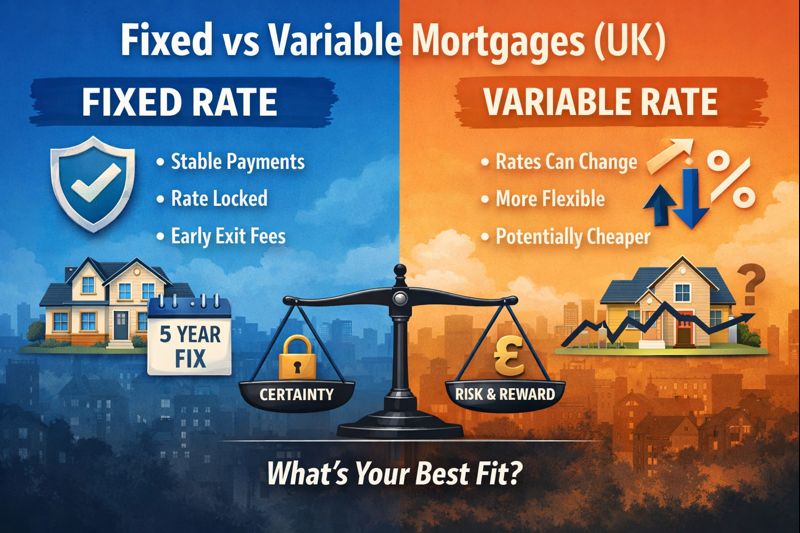
A fixed rate is mainly a risk-management tool. You give up some flexibility and potential upside in exchange for certainty. A variable rate offers flexibility and sometimes lower cost, but with less certainty.
Before comparing rates, define your risk boundary. Ask yourself:
- If your mortgage payment rose noticeably, could you still cover it alongside normal bills and essentials?
- Would you cope without relying on credit cards, overdrafts, or “hoping next month is better”?
- Do you have a cash buffer (an emergency fund) that could cover a few months of higher costs?
If the honest answer is “that would be tight,” the value of a fixed rate is not theoretical. It is protection against a budget shock.
Example: On a £200,000 mortgage over 25 years, a 1% increase in the interest rate can add roughly £120–£130 a month to the payment. For some households that is manageable; for others it changes what is affordable. This is why understanding payment risk matters more than trying to predict rates.
Fixed-rate mortgages: what you get, what you give up
Fixed rates are simple in concept: your rate is locked for a set period. That predictability is often the deciding factor for households with limited slack in their budget.
What fixed rates are good for
- Predictable monthly payments during the fixed term.
- Easier planning for childcare costs, one-income periods, or other fixed commitments.
- Lower stress if you are uncomfortable with the idea of rising payments.
What people often miss with fixed rates
- Early repayment charges (ERCs): Many fixed deals charge a fee if you leave early, even if you want to switch because rates fall.
- Porting rules: You may be able to take the mortgage with you if you move, but it is not automatic. Affordability checks still apply.
- Overpayment limits: Some deals restrict how much you can overpay each year without charges.
A fixed rate is not automatically “inflexible”, but it usually comes with conditions. If you expect major life changes, those conditions matter as much as the headline rate.
Variable-rate mortgages: tracker vs SVR vs discounts
Variable mortgages can work well, but only if you understand what drives the rate changes and what your plan is if payments rise.
Tracker mortgages (often the clearest variable option)
Trackers usually move directly with the Bank of England base rate, making them easier to understand than SVR-based deals.
Key things to check:
- Is it a true base-rate tracker with a fixed margin?
- Is there a floor or a cap on the rate?
- Are there ERCs, and for how long?
SVR (the default rate you usually want to avoid staying on)
SVR is set by the lender and can change even when the base rate does not. It is often significantly higher than rates on new deals. Many borrowers end up on SVR simply because they do nothing when their fixed term ends.
A practical step: note your deal end date well in advance so you can review options before drifting onto SVR.
Discount variable deals
Discount variable mortgages offer a discount off the lender’s SVR for a set period. They can be useful in specific situations, but you still take SVR risk because the lender controls the underlying rate.
How long do you expect to keep the mortgage or stay in the property?
Your plans often matter more than small rate differences.
- Likely to move within 0–3 years: Flexibility matters. Shorter fixes or low-ERC options reduce the risk of paying charges when you move.
- Staying put for 3–10+ years: Longer fixes can make sense if you value stability and do not want to remortgage frequently.
This is not about finding the perfect deal. It is about avoiding a mismatch between the mortgage and your life plans.
A simple decision framework you can actually use
Choose fixed if most of these are true
- Your budget would be uncomfortable if payments rose.
- You prefer certainty over optimisation.
- You have limited emergency savings.
- You have other fixed commitments or income uncertainty.
Consider variable or tracker if most of these are true
- You can comfortably absorb payment increases.
- You have a solid cash buffer.
- You value flexibility around switching, moving, or overpaying.
- You understand the difference between tracker and SVR and have a plan for both.
If you are stuck between the two, run a simple stress test. Work out what your payment would be if rates were meaningfully higher and decide whether you could live with that outcome. If the answer is no, that is a clear signal — not a personal failure.
Fees, ERCs, and total cost: what to compare
Headline rates alone can be misleading, especially over short fixed periods.
When comparing deals, focus on:
- Total cost over the period you expect to keep the deal: interest paid plus product fees.
- ERC risk: what it would cost to switch or sell early.
- Flexibility: overpayment limits, porting conditions, and term changes.
Common pitfalls in real life
- Drifting onto SVR: The fixed term ends and nothing is reviewed.
- Choosing a deal that punishes change: Cheap rates paired with heavy ERCs.
- Overestimating future income: Assuming bonuses or promotions will cover higher costs.
- Ignoring full housing costs: Insurance, repairs, and bills matter too.
Good mortgage decisions are often boring. They reduce the chance of being forced into bad choices later.
When speaking to an adviser is worth it
If your situation is straightforward, choosing between fixed and variable is often a personal risk decision. But getting advice can be helpful if you have added complexity, such as:
- Self-employed or irregular income.
- Adverse credit history.
- Interest-only or later-life borrowing needs.
- Non-standard property types.
In the UK, mortgage advice is regulated by the Financial Conduct Authority (FCA), which means advisers must recommend products that are suitable for your circumstances.
A good outcome is not just approval. It is a mortgage you can keep paying comfortably even if life gets noisy.